

How backups work
Backups don’t count toward the database’s storage. All times in backup names and schedules are UTC.
Snapshot backups on Google Cloud
Automatic backups
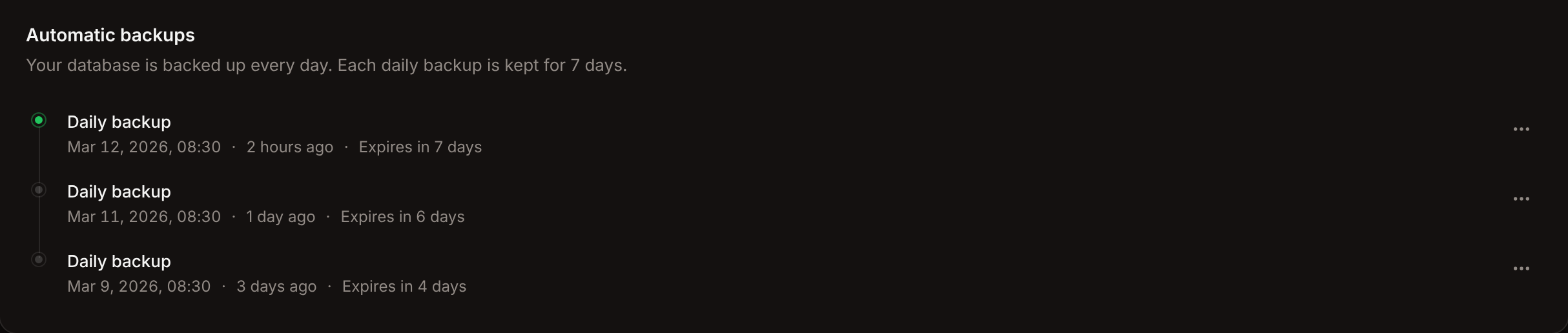
Sevalla snapshots every database in a Google Cloud location once a day and keeps each snapshot for 7 days. You can’t turn this off or delete an automatic backup. On the Backups tab, Automatic backups lists them newest first as Daily backup, with when each was taken and when it expires. A new database gets its first one within a day.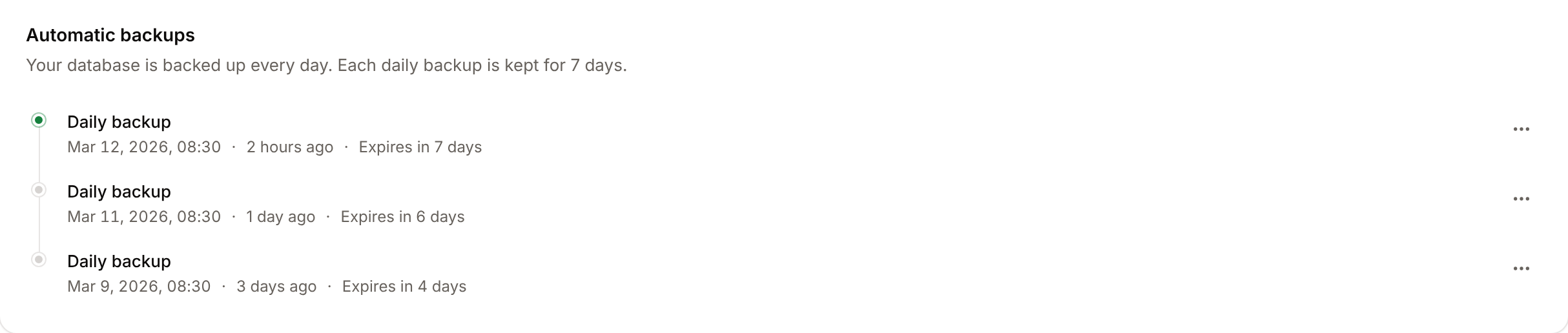
Create a manual backup
Take a manual backup before a risky change, such as a migration. You can keep 5 manual backups, each for 14 days.1
Open the backups
In the sidebar, click Databases, then click the database. Click the Backups tab.
2
Start the backup
Under Manual backups, click Create backup.
3
Describe it
Enter a Backup note that says what it’s for, for example
Before the pricing migration (up to 200 characters), then click Create database backup.- With 5 manual backups already, Sevalla doesn’t create a sixth: delete one first.
- You can’t create a backup while the database is suspended, while another change is running, or while another backup is being created.
Delete a manual backup
Under Manual backups, click the menu (…) next to the backup, click Delete, then click Delete backup. You can’t undo it. Automatic backups expire on their own and can’t be deleted.External backups on OCI
A backup target is an S3-compatible bucket that receives dump backups of the database. A database can have up to 5 targets, each with its own schedule and retention, for example a daily dump to a Sevalla bucket and a weekly one to a bucket at another provider. If you kept External backups on when you created the database, it already has one target: a Sevalla bucket with a daily dump kept 7 days.Add a backup target
1
Open the external backups
In the sidebar, click Databases, then click the database. Click the Backups tab; it opens on External backups.
2
Add a target
Under Backup targets, click Add target.
3
Choose the storage
Enter a Name. Under Storage, click Sevalla object storage and choose the Object storage, or click External S3 bucket and enter the bucket’s details.
4
Set the schedule and retention
Keep Scheduled backups on, choose the Schedule, and set how many days to keep automatic and manual backups.
5
Save
Click Add backup target.
Each dump’s file name holds its time (UTC), type, engine and version, then the target’s name for an automatic dump or the backup’s name for a manual one, for example
20261018-000000_automatic_pg17_orders-db-backups.sql.gz. After each run, Sevalla deletes the dumps under the target’s prefix that are older than their retention.
A Sevalla bucket that’s a backup target can’t be deleted: Sevalla refuses with Object storage "<id>" is used as a database backup target and cannot be deleted. Delete the backup target first. When you roll the bucket’s access keys, the backup target gets the new keys automatically.
Update or delete a backup target
On the target’s card, click the menu (…):- Update target opens the same form. Leave Access key and Secret key empty to keep the current keys; if you change the storage, bucket, endpoint or region of an external bucket, enter both keys again. Click Update backup target.
- Delete target stops its scheduled backups. Click Delete target to confirm. Dumps already in the bucket aren’t deleted, but they no longer appear on the Backups tab.
Create a manual dump backup
On the target’s card, click Create backup, enter a Backup name, then click Create backup. Each target keeps up to 5 manual backups, for as many days as its Manual retention (days). At 5, delete one before creating another.Download a dump backup
In the target’s backups table, click the menu (…) next to the backup, then click Download. The file is gzip-compressed: a plain SQL dump for PostgreSQL, MySQL and MariaDB, an RDB file for Redis and Valkey. Download works for Sevalla object storage targets; for an external bucket, download the file with that provider’s tools.Delete a dump backup
In the target’s backups table, click the menu (…) next to the backup, click Delete, then click Delete backup. The file is removed from the bucket. You can’t undo it.Restore a backup
Restoring replaces all the data in a database with a backup’s contents. You can restore into the database the backup came from, or into another compatible database, which leaves the source untouched.1
Pick the backup
On the database’s Backups tab, click the menu (…) next to the backup, then click Restore.
2
Choose where it goes
Click Restore to source, or click Restore to different database and choose the Target database.
3
Confirm
Type the permanent name of the database that will be overwritten, for example
orders-db-k3j4h, then click Restore backup.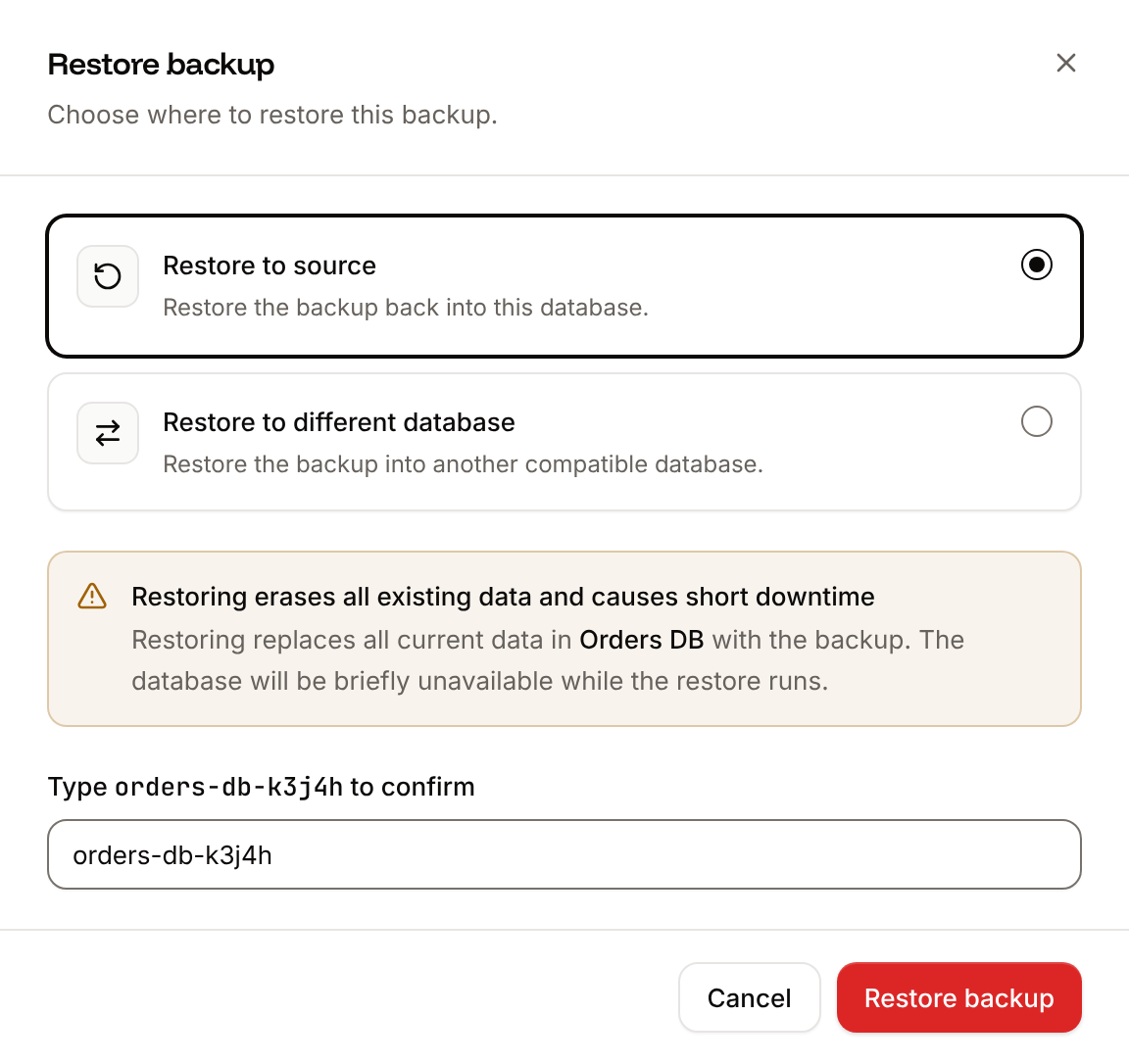
What a restore changes
- All data is replaced. Everything written after the backup was taken is lost from the database you restore into. Take a manual backup first if you might need it.
- Downtime. A snapshot restore makes the database briefly unavailable. A dump restore makes it unavailable while it runs, which takes longer the larger the dump is. A dump restore that runs longer than 1 hour is stopped and fails.
- Credentials stay. The restored database keeps its own user, password, hostnames and external connection. Connected applications don’t need new variables.
- Engine details. A MySQL or MariaDB snapshot restored into a different database gives the target the source’s database name. A PostgreSQL dump restore runs in one transaction, so if it fails nothing changes. A Redis or Valkey dump restore first empties every logical database.
Which databases can receive a restore
The Target database list shows only databases that qualify and that you can access; No compatible database found means there are none. You can’t start a restore while the source database is suspended, while a restore is running, or while a backup is being created.
Restore history
On the Backups tab, click Restore history to see the last 20 restores into this database, newest first: when each was Requested, the Backup, its Type (Snapshot or Dump), its Status (Pending, Running, Completed or Failed; point at a failed one to see why) and its Duration.Backups when you delete a database
Deleting a database deletes its snapshot backups with it. You can’t undo it. Dump backups stay in their buckets until their retention runs out or you delete them, and you can still restore them into another database with the engine’s tools (see Import and export). Before you delete a database in a Google Cloud location, export the data if you might need it.API and CLI
To restore into another database through the API, pass
target_database_id. Creating a snapshot backup returns 400 for a database in an OCI location. Backup targets and dump backups have their own endpoints under /databases/{id}/backup-targets and /databases/{id}/external-backups; see the API reference.