

Sections
Without the permission, a button is disabled and its tooltip says why. See Users and roles.
Details
Every value has a copy icon. To use them, see Connect with the S3 API. To move the bucket into or out of a project, use the project’s Services tab: see Projects.
Access keys
Access key and Secret key are the credentials S3 clients sign requests with. They’re masked: click the eye icon to show a key, or the copy icon to copy it. Keep the secret key private, and roll the keys if it leaks.Roll the access keys
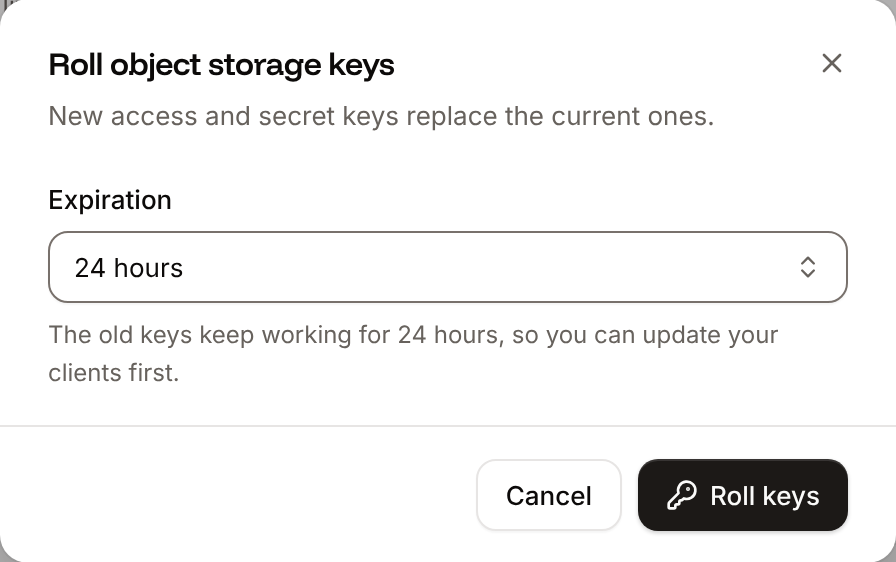
Rolling the keys creates a new access key and secret key. The old ones keep working for a grace period you choose, so you can update your clients first.1
Open the dialog
In Access keys, click Roll keys.
2
Choose how long the old keys keep working
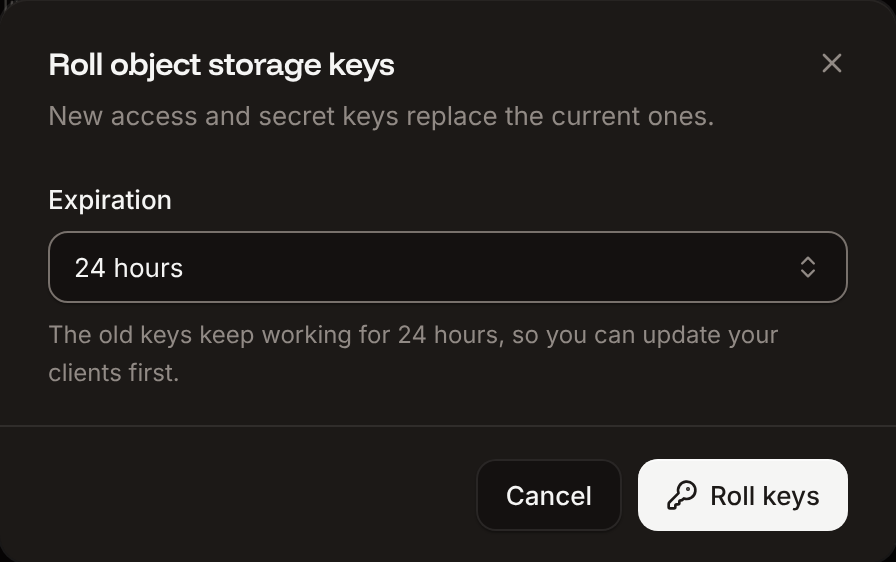
In Expiration, pick the grace period. The default is 24 hours.
3
Roll the keys
Click Roll keys. The dialog changes to Your new keys, with the New access key and New secret key and the time the old keys stop working.
4
Update your clients
Copy the new keys into every application, tool and CLI profile that uses the bucket, and deploy the applications. See Update your clients after you roll the keys. Then click Done.
Public access
Buckets are private: every request needs the keys. Public access gives the bucket a public domain,<bucket-name>.sevalla.storage, where anyone can read any object at https://<bucket-name>.sevalla.storage/<key>, through Cloudflare’s CDN. The public domain is read-only, and you can’t use a custom domain for a bucket.
Enable public access
1
Start
In Public access, click Enable public access.
2
Confirm
In the dialog, click Enable public access.
media-assets-h3k9p.sevalla.storage, with a copy icon and a link that opens it. The domain also appears next to the bucket’s name at the top of its pages.


Disable public access
In Public access, click Disable public access, then click Disable public access in the dialog. The public domain stops serving the bucket’s objects, so links to them stop working. The objects themselves and the S3 API aren’t affected. If you enable public access again, the bucket gets the same domain, because it’s made from the bucket name.CORS policy
CORS rules tell browsers which other websites may use the bucket’s contents: for example, a page onhttps://shop.example.com that loads images from the public domain or uploads with a presigned URL. Without a rule, browsers block those requests. A bucket has no CORS rules when you create it, and each rule you create is added to the others.
The table lists each rule’s Allowed origins, Allowed methods and Allowed headers.
Create a CORS rule
1
Open the sheet
In CORS policy, click Create rule.
2
Choose the methods
Under Allowed methods, select the HTTP methods to allow.
3
Add the origins
Under Allowed origins, enter each site’s origin, such as
https://shop.example.com. Click Add allowed origin for more.4
Add the headers
Under Allowed headers, enter the request headers browsers may send, such as
Content-Type, or remove them all. Click Add allowed header for more.5
Create the rule
Click Create CORS rule.
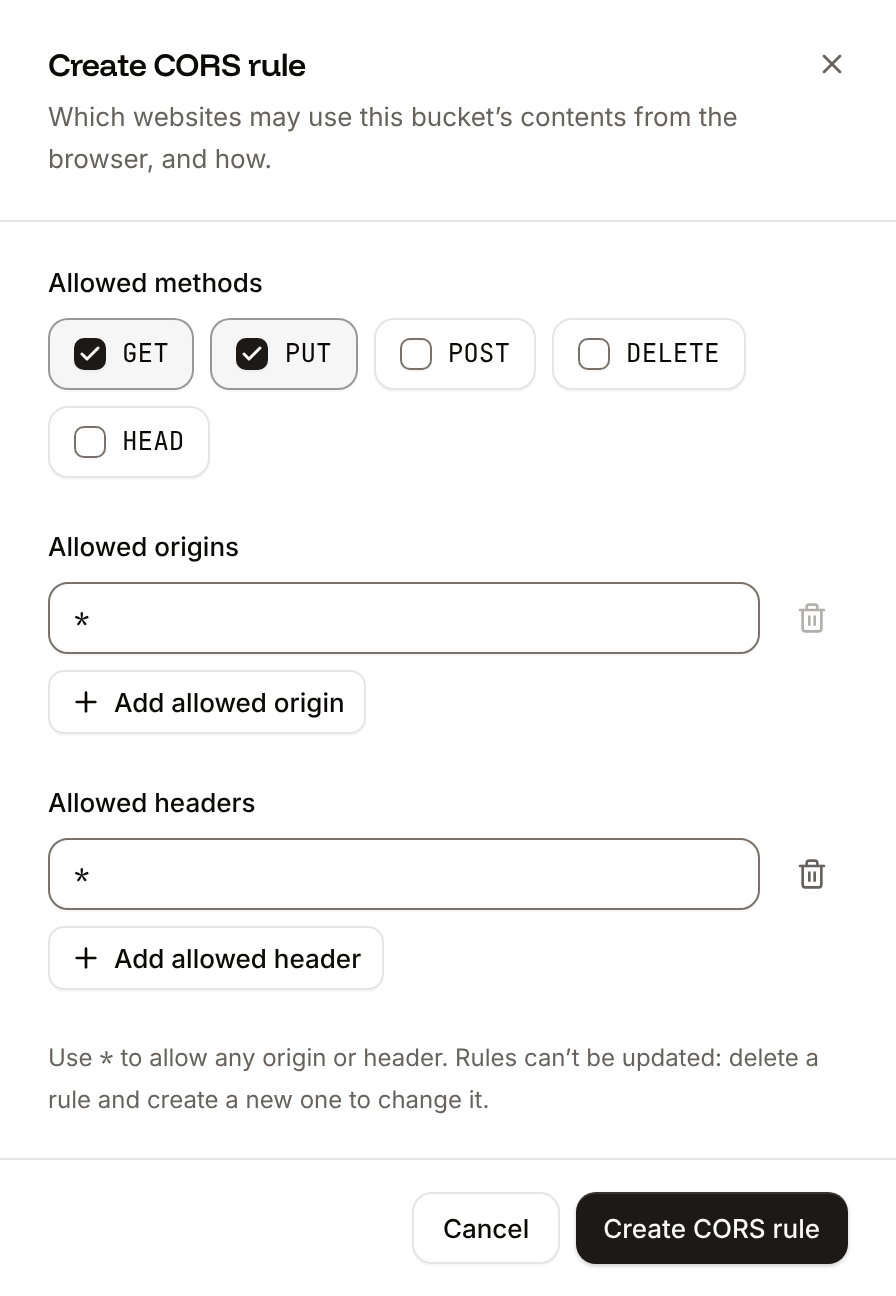
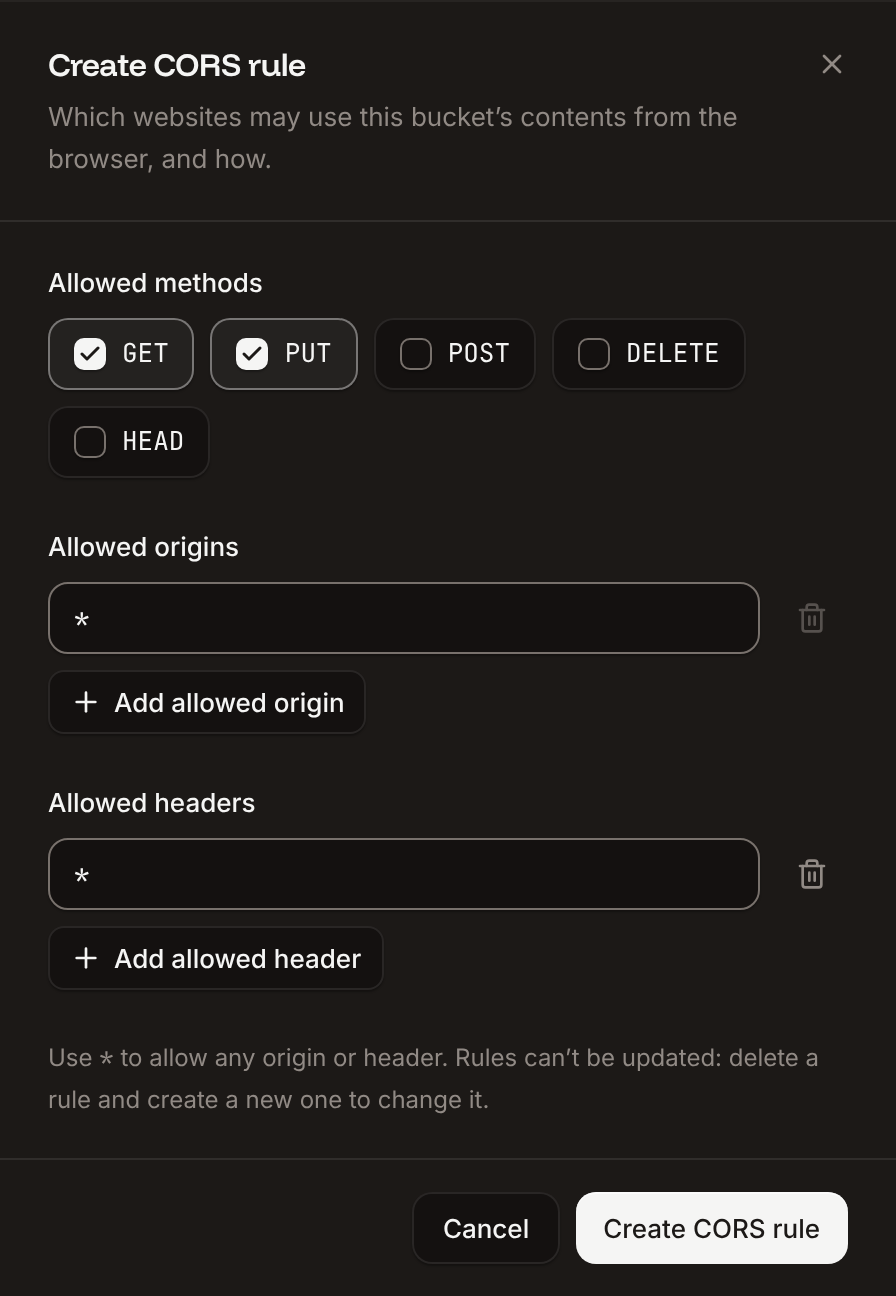
*. Rules don’t set exposed response headers or a cache time for preflight requests.
Delete a CORS rule
Rules can’t be updated in the dashboard: to change one, delete it and create a new one. Click … at the end of the rule, click Delete, then click Delete rule. Browsers on the rule’s origins lose the access it gave them.Purge the CDN cache
Cloudflare’s CDN caches objects served from the bucket’s public domain. After you replace or delete files, visitors can still get the cached copies. Purging removes every cached copy, so the next requests get the bucket’s current files. In CDN cache, click Purge cache. There’s no confirmation: the dashboard shows Cache purged. when it’s done. Purging only matters with public access on. Requests to the S3 endpoint and presigned URLs aren’t cached.Delete a bucket
Deleting a bucket deletes every object in it, revokes its keys and removes the bucket.1
Open the dialog
In Danger zone, click Delete object storage.
2
Confirm with the bucket name
Type the bucket name, such as
product-images-x7k2m, then click Delete object storage.Object storage "<id>" is used as a database backup target and cannot be deleted.
API and CLI
Through the API and CLI, rolling keys revokes the old keys immediately unless you pass a grace period (
old_keys_ttl_hours, --old-keys-ttl-hours, 0 to 168).