

 Every guide in this section was followed on Sevalla from an empty folder. Guides for code you write build with Ingot and with a Dockerfile; guides for packaged tools deploy the vendor’s official Docker image. Each one ends with the same deployment as API calls, so an AI agent can run it.
MCP servers
MCP server with TypeScript
A remote MCP server on Streamable HTTP with the official TypeScript SDK, bearer token auth and PostgreSQL tools.
MCP server with Python
The same server with the official Python SDK and uv, stateless so it runs on several instances.
Agents
Claude Agent SDK
An agent with custom tools behind an HTTP API, a background worker and sessions in PostgreSQL.
OpenAI Agents SDK
Agents with tools and a handoff, streamed by FastAPI, with sessions in PostgreSQL.
LangGraph
A tool-calling graph with the PostgreSQL checkpointer and a human approval step.
Mastra
A TypeScript agent with a tool, a workflow and memory in PostgreSQL.
Claude Code
A Claude Code session in the cloud that you open from the web terminal and that keeps working when you leave.
Agent swarm
A builder and a reviewer agent that work through GitHub pull requests, and a queue between them.
Chat and retrieval
AI chatbot
A Next.js chatbot with the AI SDK that streams answers and saves chats in PostgreSQL.
RAG with pgvector
Embeddings in PostgreSQL with an HNSW index, and answers that cite their sources.
Qdrant
A private vector database on a disk, with snapshots in object storage.
Models and tools you host
Ollama
Open models on CPU in a private application, with measured speeds per size.
LiteLLM
One OpenAI-compatible endpoint for every model, with a key and budget per application.
OpenRouter
Models from many providers through one API, with fallbacks and cost per key.
Open WebUI
A private chat interface for your team, connected to LiteLLM and Ollama.
n8n
Workflow automation with AI agent nodes, scaled with queue mode and workers.
Langflow
Visual AI flows that you run through Langflow’s API.
Langfuse
Tracing, cost and evaluation for your model calls, self-hosted.
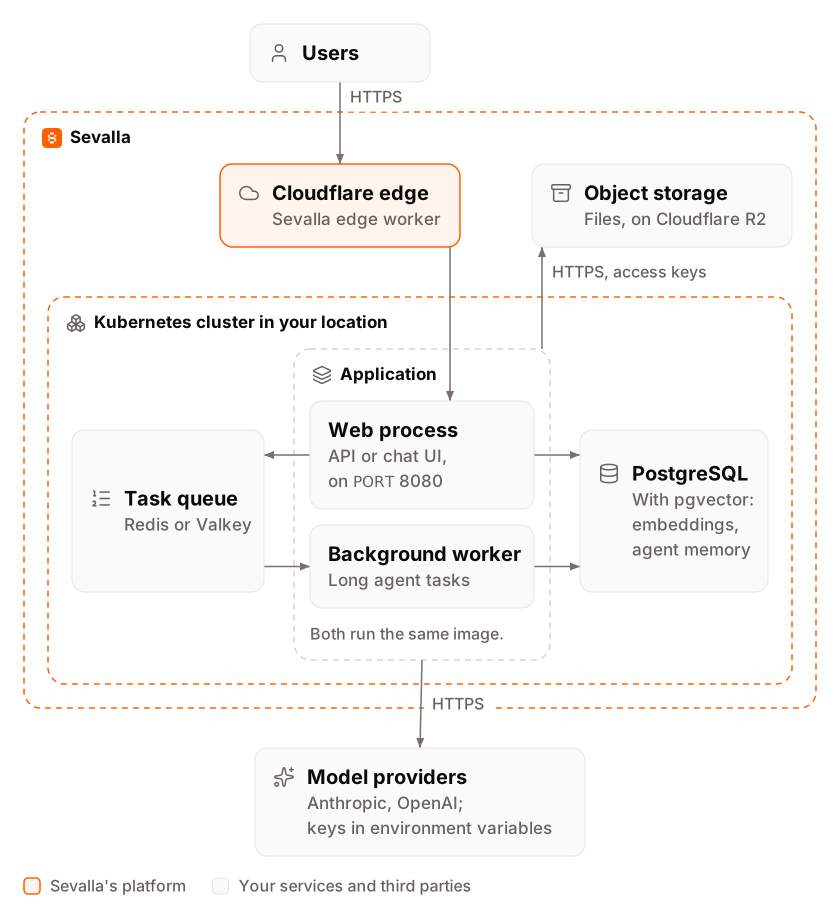
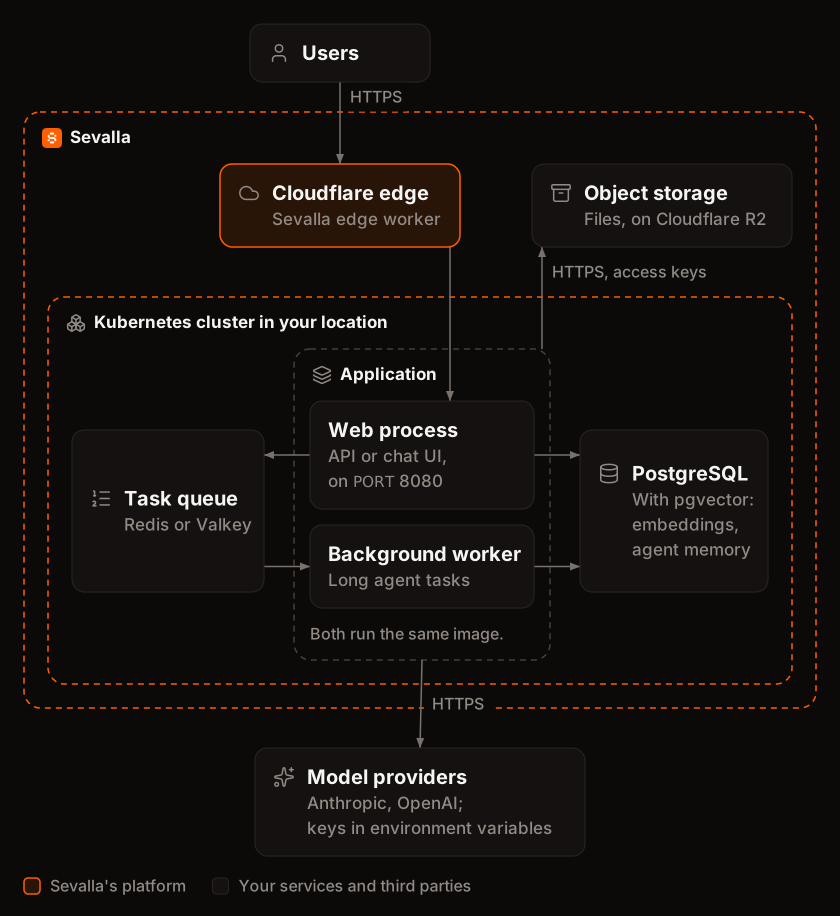
How AI applications run on Sevalla
Keep AI applications secure
- Authenticate every public endpoint that can spend money or call tools, at least with a bearer token in an environment variable.
- Never expose an agent with shell or write tools to the internet. Turn its HTTP traffic off and reach it through the web terminal or an internal connection.
- Treat what an agent reads as untrusted. Pull requests, web pages, tickets and tool results can carry prompt injection, so let your code, not the model, take irreversible actions such as merging, paying or deleting.
- Give agents least-privilege tokens, such as a fine-grained GitHub token for one repository, and set spending limits on your model provider accounts.